
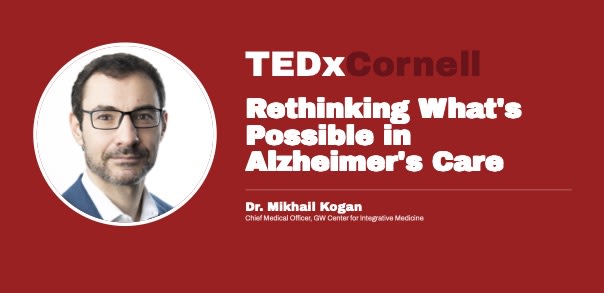
Rethinking What's Possible in Alzheimer's Care
We're proud to share that our own Dr. Mikhail Kogan recently took the TEDxCornell stage, and his talk is well worth the watch. For decades, an Alzheimer's diagnosis has come with an unspoken assumption: once cognitive decline starts, it only moves in one direction. In "A Holistic Approach to Cognitive Care," Dr. Kogan, Chief Medical Officer of the GW Center for Integrative Medicine and Associate Professor of Medicine at George Washington University, challenges that assumption directly.
Dr. Kogan has spent nearly twenty years practicing at the intersection of geriatrics and integrative medicine, and chief-edited Integrative Geriatric Medicine, the field's definitive textbook published by Oxford University Press. In this talk, he lays out what that intersection actually looks like in practice: care that treats the brain not as an isolated organ in decline, but as part of a whole system shaped by inflammation, sleep quality, nutrition, chronic stress, and environmental exposures.
That distinction matters more than it might sound. Conventional Alzheimer's care has largely focused on managing symptoms once they appear. Dr. Kogan's talk points to a different starting question: what is driving the decline in the first place, and how much of that is modifiable? Inflammation, for example, is the body's immune response running in the background for too long, and it's increasingly linked to cognitive decline. Sleep disruption interferes with the brain's ability to clear metabolic waste overnight. Nutrition gaps and chronic stress compound both. None of these are exotic; they're everyday factors that a whole-person evaluation can identify and address alongside standard medical care.
The result, in some of the patient stories Dr. Kogan shares, is not just a slower decline but real stabilization and, in certain cases, a genuine return of cognitive function that had been assumed permanent. He frames this within emerging neuroscience on the brain's capacity for resilience: the idea that under the right conditions, the brain can adapt and recover more than it's traditionally been given credit for.
This is not a claim that integrative approaches replace conventional Alzheimer's treatment, and Dr. Kogan is careful not to frame it that way. It's a case for combining the two: personalized, prevention-oriented care layered onto the medical management patients already receive. That's the model GWCIM has built its Memory Program around, treating the whole person rather than a single diagnosis in isolation.
Dr. Kogan's broader work reflects this same philosophy. Beyond his role at GWCIM, he founded the AIM Health Institute, a nonprofit that provides integrative medicine services to low-income and terminally ill patients in the Washington, D.C. area regardless of ability to pay, and serves on the National Cancer Institute's CAM PDQ Board and the American Board of Integrative Medicine.
If you or someone you love is navigating cognitive decline, or simply wants to understand what's within your control as you age, this talk is a good place to start. Watch the full talk to hear Dr. Kogan's patient stories and the research behind them, and visit www.gwcim.com to learn more about GWCIM's Memory Program and integrative approach to cognitive health. Congratulations to Dr. Kogan on a well-deserved TEDx stage, and thank you for continuing to bring this work to a wider audience.
